
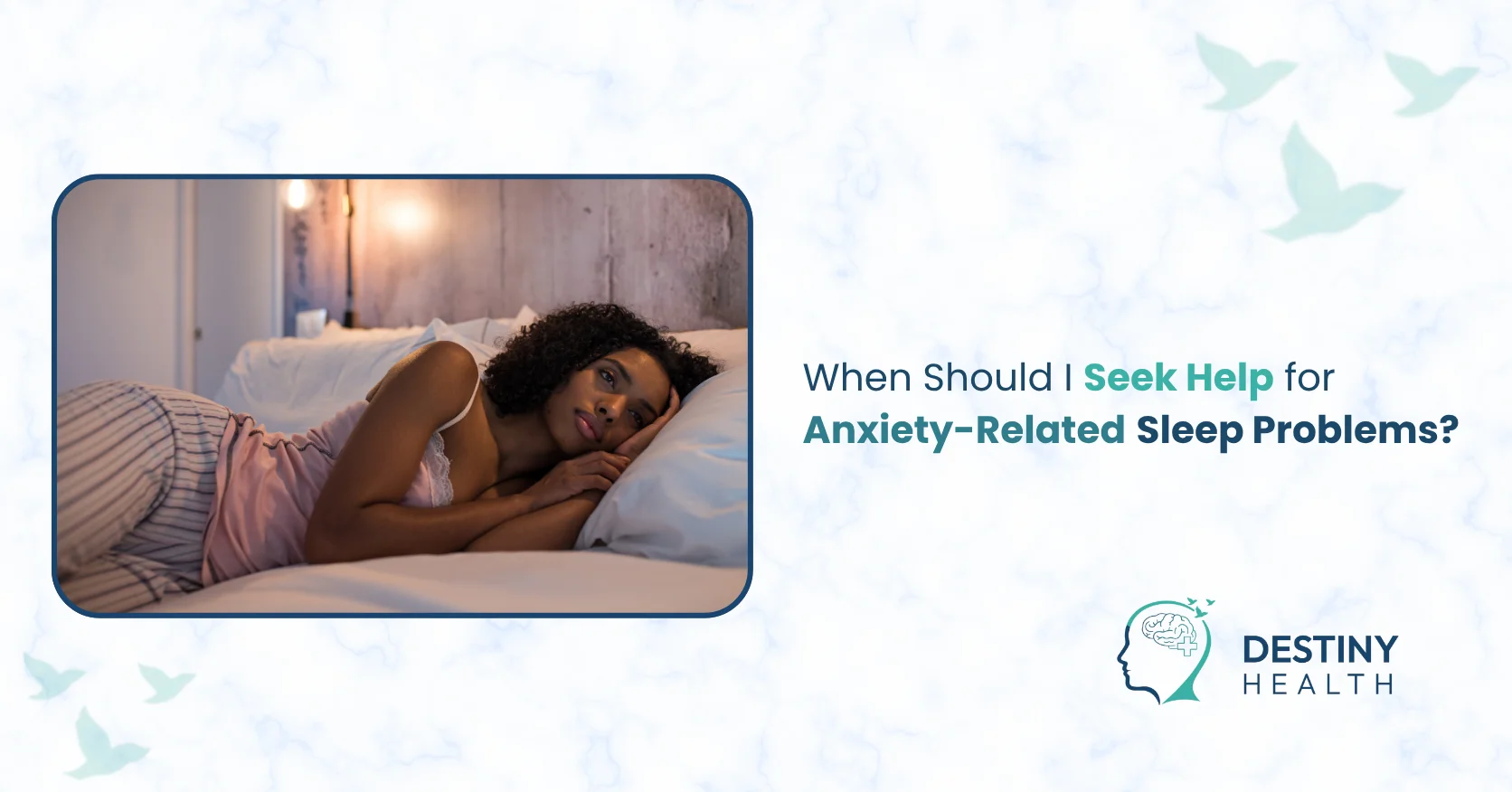
You’re lying there late at night again. Body exhausted, mind wide awake, running through tomorrow’s to-do list, then last week’s awkward conversation, then something you said in third grade for some reason.
Tomorrow you’ll be tired and short-tempered and wonder how long you can keep running on five hours of broken sleep before something gives.
Here’s the honest answer: it depends less on how bad one night feels and more on how many nights have looked like this in a row, and what it’s doing to your life during the day.
Why anxiety and sleep feed each other.
This isn’t just in your head, or rather, it is, but not in the dismissive way that sounds.
Anxiety and poor sleep run on a loop. Worry keeps your nervous system activated at bedtime, which makes it harder to fall asleep or stay asleep.
Then the sleep loss itself makes your brain more reactive to stress the next day, so the worry gets louder, and the cycle repeats.
Researchers actually have decent data on this. Sleep Foundation describes it as a self-reinforcing relationship, where worrying causes poor sleep and poor sleep causes more anxiety, feeding into each other rather than one simply causing the other.
Some studies have gone further and found that sleep disturbance might actually be the stronger driver of the two.
A large cohort study published through ScienceDirect found that poor sleep nearly doubled the risk of developing anxiety symptoms, while anxiety raised the risk of sleep problems by a smaller margin. Either way, once the loop starts, it doesn’t usually break on its own.
When it’s still “just a rough patch.”
Not every bad night needs an appointment. If you’ve had a stressful week, a big deadline, a fight with someone you love, and you’re sleeping poorly because of it, that’s a normal nervous system doing what nervous systems do.
A few nights of restless sleep tied to an obvious, temporary cause usually resolves once the stressor passes.
When it’s time to actually get help.
If sleep problems are making it hard to function during the day, that’s the signal to see someone. A few specific markers worth paying attention to:
- It’s been going on for more than a few weeks, not just a few rough nights
- You’re tired, irritable, or foggy enough that it’s affecting work, relationships or basic tasks
- You’re dreading bedtime itself, not just dealing with occasional restlessness
- The anxious thoughts at night have started showing up during the day too
- You’ve tried the basics (consistent bedtime, less screen time, cutting caffeine) and nothing’s shifted
- You’re relying on alcohol, sleep aids, or anything else just to get a few hours down
Cleveland Clinic frames the general rule the same way: if you’re struggling to get decent rest more nights than not, it’s worth having it checked out rather than waiting to see if it fixes itself.
What “getting help” actually looks like.
It doesn’t automatically mean medication, and it doesn’t mean you’ve failed at managing this on your own. A provider will usually start by asking about your sleep patterns, your anxiety symptoms, and anything else going on, sometimes with a sleep diary you keep for a week or two beforehand.
From there, treatment often includes therapy geared specifically toward the anxiety, sometimes CBT-I (cognitive behavioral therapy for insomnia), which several major health systems point to as one of the more effective long-term approaches for sleep issues tied to anxious thinking. Medication can be part of the picture too, depending on what’s driving things, but it’s rarely the first or only step.
A note on physical symptoms.
If you have symptoms that make sleep challenging, like your heart racing, you wake up short of breath, or your chest is tight, or it feels like “more than just anxious”, make sure to bring that up in particular. Sometimes, the sleep loss has a different cause and is accompanied by a different condition, such as sleep apnea. It’s not too late to ask questions, and a provider can help to clarify the difference.
You don’t have to wait until it’s unbearable.
A lot of people wait until they’re completely worn down before reaching out. There’s not a threshold of suffering you need to hit first.
If anxiety is keeping you up more nights than not, that’s already reason enough.
At Destiny Health, Mercy Oyerinde, PMHNP-BC, works with clients on both the anxiety and the sleep side of this, not just one or the other, because treating them separately rarely works for long. If this sounds familiar, book an appointment and let’s get you actual rest again.