
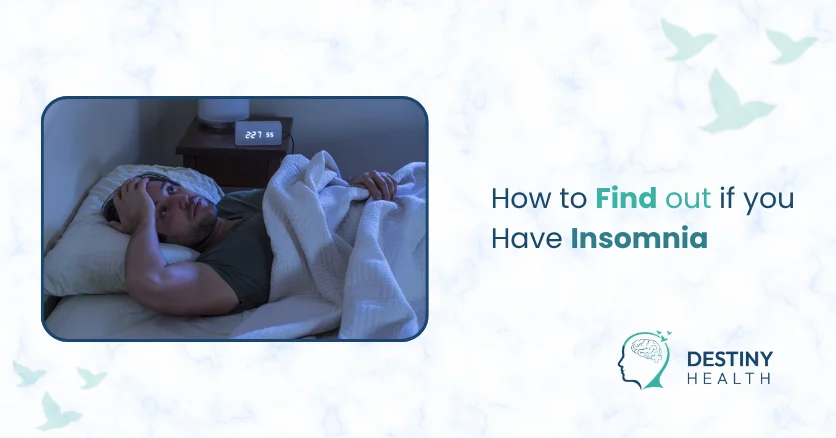
A few bad nights of trouble sleeping after a stressful week is not insomnia. But sleep and sleeplessness that follows you week after week is a different thing, and knowing the difference is useful before you start trying to fix it.
The Clinical Definition
According to the DSM-5, insomnia disorder means having difficulties sleeping, whether that’s falling asleep, staying asleep or waking too early and not getting back down, at least three nights a week, for at least three months, despite having enough time set aside for sleep.
It also has to be affecting how you function during the day. Fatigue, trouble concentrating, mood changes, performance slipping at work or home.
Episodes shorter than three months are called acute or short-term insomnia. Still worth addressing, but treated differently than the chronic version. Severe insomnia that has been running for years without treatment often needs a more structured approach than someone dealing with a recent onset.
The Different Types
Some people can’t sleep at night at all, lying there an hour, sometimes longer, most nights. Some fall asleep fast but wake at 1 or 2am and that’s it. Some wake up repeatedly. Some wake at 3 or 4am feeling weirdly alert, a flat kind of awake that doesn’t lead anywhere regardless of how tired they were.
If you find yourself saying “I can’t sleep at night,” but the pattern shifts, some nights it’s falling asleep, some nights it’s staying asleep, that mixed presentation is common too.
Signs of Insomnia to Watch For
- Difficulty sleeping at night three or more nights a week, consistently, for more than a month
- Lying awake most nights for 30 minutes or more before sleep comes
- Waking in the night and staying awake for 30 minutes or longer
- Waking much earlier than you need to and not getting back to sleep
- Daytime functioning actually being affected, concentration, mood, memory, energy
- Starting to dread going to bed
- Organizing your day around the sleep problem, napping to compensate, going to bed earlier, cancelling things
What’s Usually Behind It
The most common insomnia causes involve anxiety, depression and lifestyle factors that compound each other.
Anxiety keeps the brain running at night, and over time the bed itself starts to feel like a place where you lie awake and worry.
Clinicians call this conditioned arousal. People with chronic insomnia often sleep fine away from home, in a hotel or at someone else’s place, because the association isn’t there.
Depression specifically disrupts sleep architecture. It compresses slow-wave sleep and pushes REM earlier. The waking at 3 or 4am pattern, that hollow alertness, is one of the most consistent signs of depression-related sleep disruption.
Caffeine has a half-life of five to seven hours!
Coffee at 2 pm still has half its caffeine load at 9 pm. Alcohol helps people fall asleep and then fragments sleep as it metabolizes, producing the waking-in-the-middle-of-the-night pattern.
Sleep disorders and insomnia often overlap. Sleep apnea creates fragmented sleep that looks like insomnia and won’t respond to insomnia treatment. If there’s any suspicion of apnea, that needs to get ruled out first before anything else is tried.
Getting a Diagnosis
There’s no test. A provider takes a history. How long, how often, what the nights actually look like, what you’ve tried, what else is going on in your life. Keeping a sleep diary for one to two weeks before an appointment helps a lot. Time into bed, how long before sleep, how many times you woke, time you got up, how the day went. That information is more accurate than trying to recall it during an appointment.
What Treatment Looks Like
If you are wondering how to fix insomnia long-term, CBT-I (Cognitive Behavioral Therapy for Insomnia) is the first-line treatment for chronic insomnia. The research on this is consistent and it outperforms sleep medication on long-term outcomes. It includes sleep restriction, stimulus control, and work on the anxious thinking around sleep. Requires a few weeks of consistency. The changes tend to hold after treatment ends in a way that medication alone doesn’t produce.
On how to deal with insomnia in the short term: medication is used while CBT-I is getting started. Ramelteon, low-dose doxepin, suvorexant, lemborexant are common options. Zolpidem works but carries dependency risk with extended use. Mirtazapine and trazodone, both antidepressants, get used for their sedating properties when mood is also part of the picture.
For people asking what to do when you can’t sleep due to anxiety or depression, addressing those directly often does more than treating the sleep alone.
Destiny Health
Mercy Oyerinde, PMHNP-BC, at Destiny Health works with patients whose sleep problems are connected to anxiety, depression, and mood disorders. Telehealth and phone appointments are available Monday through Friday.
If sleep has been off for a while and nothing has touched it, that’s worth bringing to a provider rather than trying more things on your own.
Phone – (770) 676-2546
Email – support@destinyhealths.com
Hours – Monday to Friday, 9:00 AM to 5:00 PM EST
Website – destinyhealths.com
Your next step does not have to be a big one. It just has to be a real one.