
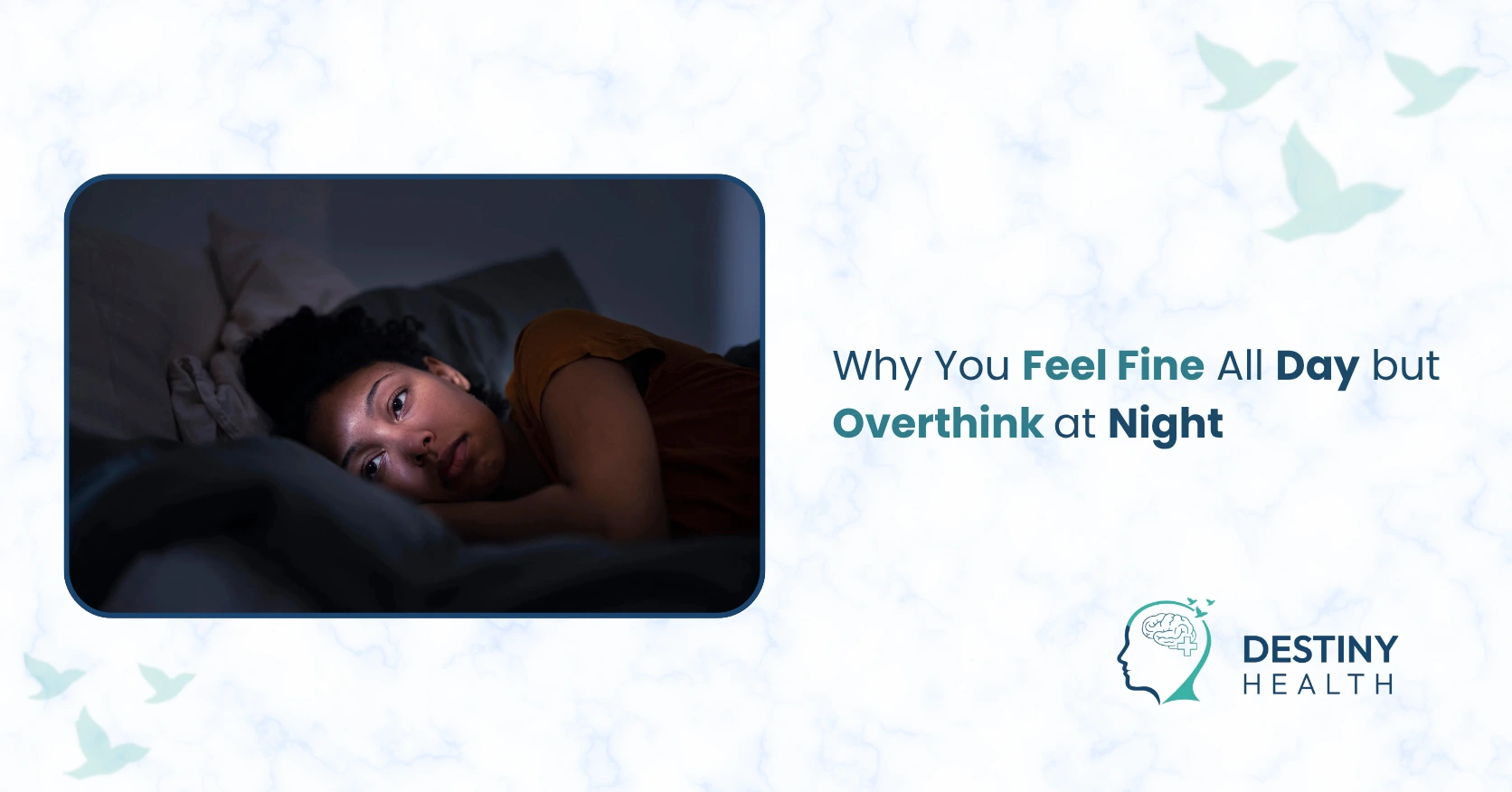
The day was fine. You got through it. Then you got in bed and your brain started going.
That thing you said at work last Tuesday. The text you sent that got a short reply. Whether you are doing enough. Whether people are actually okay with you or just being polite. It is midnight and none of this was on your mind six hours ago.
This is not random and it is not you being dramatic. There is a real reason it happens at night specifically.
Your brain stays busy on purpose during the day.
When you are moving through the day, your mind has things to do. Work, errands, responding to people, figuring out what is next. That constant activity keeps the background noise quiet. Not gone. Just quiet.
The worries do not disappear during the day. They just do not get airtime because there is always something more immediate in front of you.
Then night comes. Nothing is immediate anymore. You are horizontal in the dark and for the first time all day, there is nothing your brain actually has to do. So it starts doing the thing it has been holding off on: processing everything it did not have room for earlier.
That is not a sleep problem. That is a backlog problem.
You probably spent the day moving past things instead of through them.
Someone said something that rubbed you the wrong way. You let it go and kept moving. You felt anxious about something before a meeting. You pushed through it and moved on. A decision has been sitting in the back of your head unresolved for a week. You have been too busy to actually sit with it.
All of that is still there. You did not deal with it, you just deferred it. And at night, when there is nothing left to defer to, it surfaces.
Most people do this without realizing it. Pushing through things feels productive during the day. It keeps you functional. The cost shows up later, usually around midnight.
Some people are more prone to this than others.
Not everyone lies awake spiraling. Some people fall asleep in minutes and wake up unbothered. So why does this happen to some people and not others?
A few things tend to drive it:
- Anxiety already running in the background means the nervous system does not fully stand down, even when the day is over and nothing is actually wrong
- Suppressing emotions during the day, sometimes without even realizing it, means they come up later when there is nothing left to suppress them with
- Unresolved stress, whether from a relationship, a job, money, or something you have not fully named yet, gives the brain more to chew on when it finally has space
- Running on overdrive for long enough that the body forgot how to actually downshift
None of this is a personality flaw. It is just a pattern that built up over time.
The part that makes it so much worse.
You are already lying there overthinking. Then you start getting frustrated that you are overthinking. Then you worry about not sleeping. Then you look at the clock and do the math on how many hours you have left. Then you start thinking about how tired you are going to be and how that is going to affect your whole day.
Now you have completely left the original worry behind. You are just anxious about being anxious, at 1am, while your body is exhausted and your brain is wide open.
That loop is one of the most draining things to be stuck in, especially when it happens most nights.
What actually helps.
Telling yourself to stop thinking does not work. You already know that.
What tends to actually help is giving the brain somewhere to put things before bed, so there is less waiting for you when you lie down.
- Write down what is on your mind before you try to sleep. Not a journal entry. Just get it out of your head. Your brain keeps cycling through things partly because it is trying not to forget them. Once they are written down, it lets go a little.
- Give yourself real wind-down time, not just screen off and eyes closed. Your nervous system needs an actual transition. Thirty minutes of something low-stimulation before bed makes a difference.
- When something bothers you during the day, let it bother you for a few minutes instead of immediately moving on. It feels like wasted time. It is actually the opposite.
These help. But if you have been doing this for months and it is affecting your sleep, your mood, and how you feel during the day, habits alone are probably not enough.
When it has gone on long enough.
There is a difference between overthinking some nights and dreading bedtime, lying awake most nights, and waking up already tired and tense every single morning.
Anxiety, depression, unprocessed stress, and trauma present themselves in this manner. Chronic and disruptive. But so silent that it becomes the norm, and they simply accept this as how they are.
It does not necessarily have to remain so. Having an actual evaluation involves a professional examining what is behind it, not merely the sleep symptoms, and determining what would really be of assistance to you in particular.
You should not have to dread going to bed every night.
At Destiny Health, Mercy Oyerinde works with people dealing with anxiety, overthinking and the kind of mental exhaustion that a good night’s sleep alone is not fixing.
We accept Medicare and Medicaid.
Call (770) 676-2546 or book at destinyhealths.com
Available Monday through Friday, 9am to 5pm EST, via telehealth.