
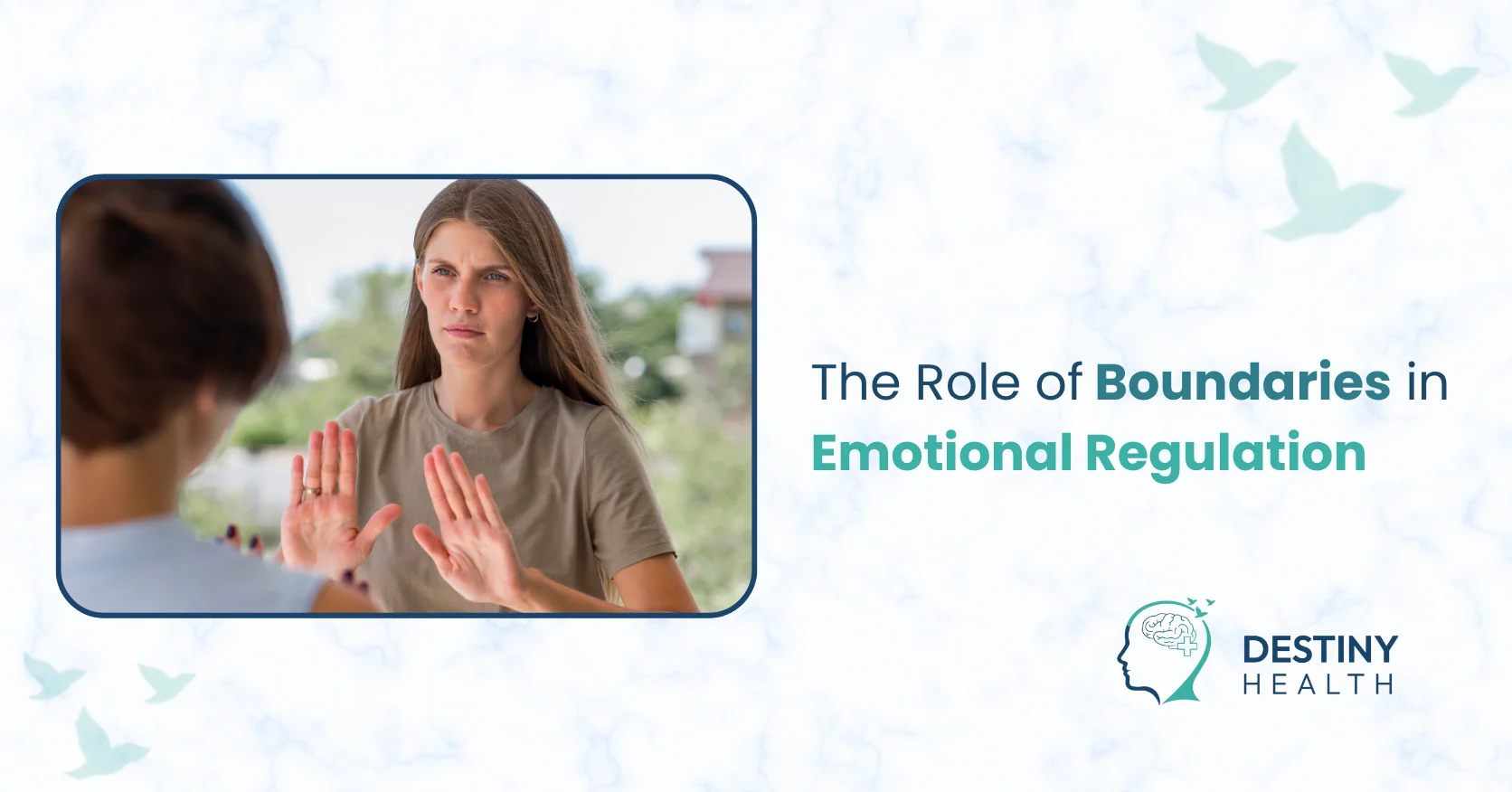
Most people have been taught about boundaries in relation to protecting themselves from the difficult people. Stay a distance of arm’s length from the person. Do not allow them to treat you in that way. While that is one way to look at boundaries, it’s not the whole picture.
The less talked about part is what happens inside you. One of the more obvious ways people self-regulate their emotions is by setting boundaries for other people’s behavior. If they’re not there, your nervous system absorbs what is happening to it all day long without any filter.
What Emotional Regulation Actually Means
Emotional regulation is different than “controlling” or “repressing” emotions. It is feeling as though there is something but not being overwhelmed by it. Recognizing when you’re feeling angry without saying something you’ll regret.
Not being so anxious that it’s shutting you down completely. Sitting with discomfort without immediately doing something to escape it.
It’s a skill, not a personality trait. Some people develop it early with the right environment and modeling.
Many people don’t because their families were not sensitive, not because they’re wrong, but because they learned to not express their emotions, to suppress their emotions, or to repress their emotions instead of processing them.
Where Boundaries Come In
If you have no boundaries, then other people’s crises, needs, moods and demands land straight on your nervous system. Your boss is stressed, so are you. Your partner is angry and you spend the evening working to fix them. A member of your family vents at you, and you take it home.
That constant absorption is really dysregulating. It’s a chronic low-level threat, and cortisol increases, your nervous system remains on guard, and in time, it affects your mood, your sleep and how you generally react.
Why People Who Struggle With Boundaries Also Struggle With Their Emotions
Clinical observations show there is a certain consistency in this: those who are having difficulty setting limits with others often find that it is difficult to set limits with themselves. The two are interlinked.
It’s part of a load on the nervous system. When you constantly take on others’ emotions, you lose your ability to regulate. There is not as much time remaining for taking care of your own affairs.
Identity is part of it. There is a fair amount of self-awareness required to know what to take and not take, what to care about and protect, and what is important and worth caring for. Individuals who were taught to suppress their own desires to please others do not necessarily have that basis and when emotions are felt without a self to which to attach them, they can become overwhelming and difficult to control.
One of the therapies most specifically designed around emotional regulation, DBT has a large emphasis on interpersonal effectiveness, which involves asking for what you need, saying no, and holding a position in a relationship. There they are not taught as a self-help skill. They’re part of the clinical framework.
What Poor Boundaries Look Like Day to Day
- Agreeing to things you don’t have the capacity for and then feeling resentful
- Feeling responsible for other people’s moods and anxious when they’re unhappy
- Saying yes and immediately dreading it
- Avoiding conflict to the point where your actual needs never get raised
- Feeling emotionally flooded after spending time with certain people
- Being unable to end conversations or interactions even when you’re overwhelmed
Any of those alone is not necessarily a problem. All of them together, running consistently, usually point to something worth working on.
Setting a Boundary Is Not the Same as Cutting People Off
This gets confused constantly. A boundary is not an ultimatum, a punishment or a wall. It is information about what you can and can’t do, what you will and won’t accept, communicated directly.
The other person still gets to do whatever they want with that information. They may push back, be upset, or disagree. That’s allowed. The boundary doesn’t require their approval to stand.
The emotional regulation piece shows up here too. Holding a limit while someone is unhappy with it requires tolerating their discomfort without immediately caving to fix it.
For people who grew up reading other people’s moods as their responsibility to manage, that is genuinely hard work, not a character flaw, just a skill that hasn’t been built yet.
Building This in Practice
Boundaries don’t come naturally when they were never modeled or when holding them was historically unsafe. They get built gradually, usually starting with low-stakes situations and working up.
- Noticing what you actually feel before deciding what to do about it
- Buying time instead of answering immediately, ‘let me think about that’ is a full sentence
- Starting with small nos in low-stakes situations and seeing what actually happens
- Separating someone else being upset from that upset being your fault or your problem to fix
- Recognizing the physical sensations that come just before you agree to something you don’t want to do
That last one is worth sitting with. A lot of people discover, when they start paying attention, that their body was already telling them something before their mouth said yes.
This Is Something Therapy Actually Helps With
Limits around what you can handle aren’t a personality trait you either have or don’t. They’re a skill, and skills can be built.
At Destiny Health, Mercy Oyerinde works with adults on just this type of work, emotional regulation, interpersonal patterns, and how you relate to others and how you feel inside using evidence-based therapeutic practices such as CBT, DBT, and mindfulness-based therapy.
Telehealth and phone appointments are available, so support is accessible wherever you are.
If you’ve been running on empty because you don’t know how to stop absorbing everything around you, that’s worth bringing to someone.
Phone – (770) 676-2546
Email – support@destinyhealths.com
Website: destinyhealths.com
Your next step does not have to be a big one. It just has to be a real one.