
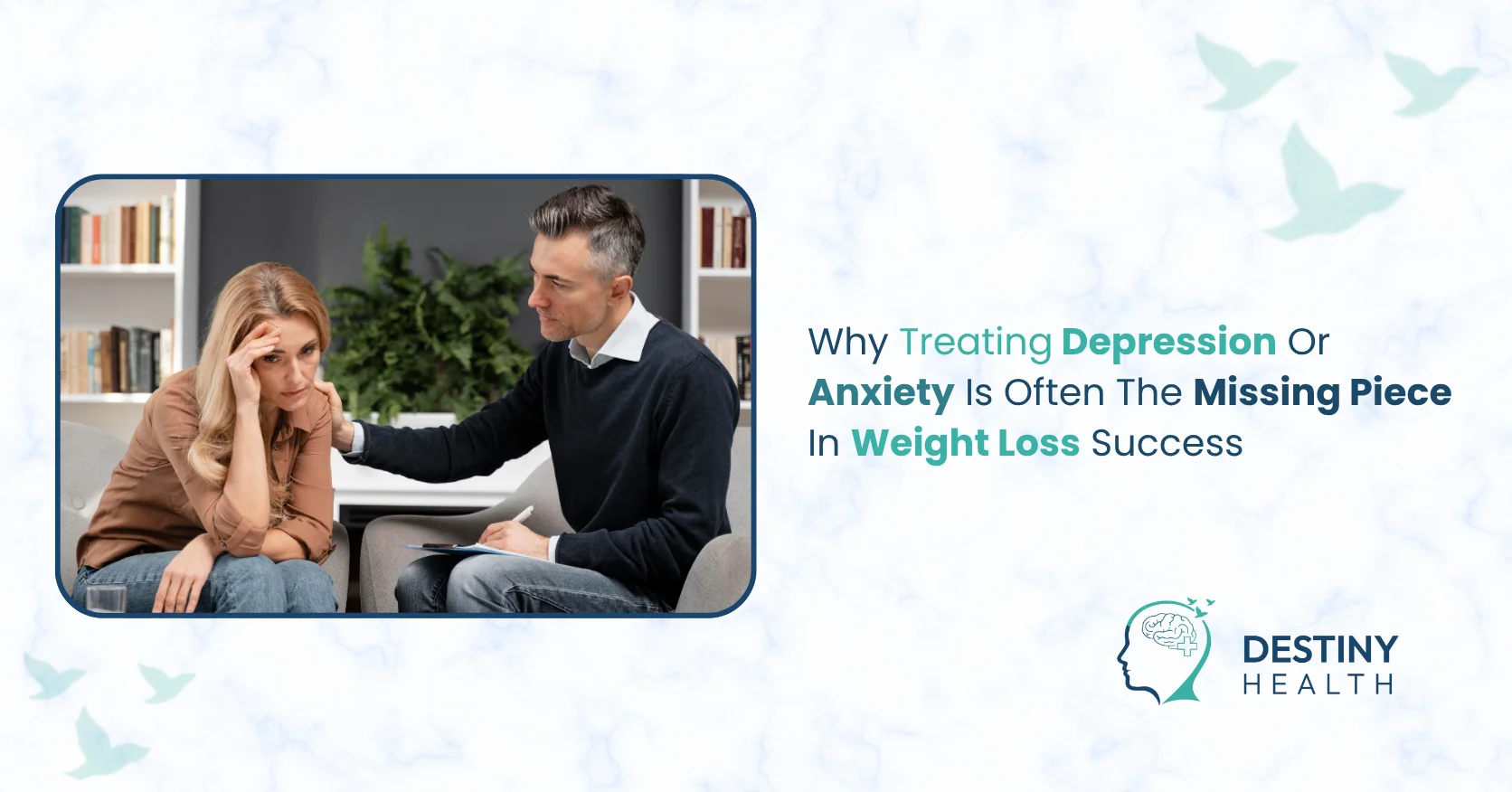
You’ve done the diet. Maybe more than once. You know what to eat, roughly how much to move, what the plan is supposed to look like. And yet something keeps getting in the way. Not ignorance. Not laziness. Something harder to name that shows up right around the point where the plan should be working.
For a lot of people that something is depression or anxiety, running quietly underneath the weight loss attempt and making it significantly harder than it has to be. Not impossible. Just hard enough, consistently enough, that the plan eventually falls apart.
What Depression Does to the Body’s Weight Regulation
Depression is not limited to just being down. It alters the regulation of satiety and hunger cues – it also alters other hormones that control hunger and fullness, and it often causes changes in eating habits unrelated to hunger.
Cortisol remains high during depression. Continuing elevated cortisol levels cause fat to be stored, especially around the abdomen, and insulin resistance to rise. In addition, it induces cravings for high calorie, high sugar foods, as the brain is attempting to create a fast “fix” for the lack of the dopamine it feels a lack of. This is why emotional eating during a depressive period isn’t weak-willed behavior. It’s the brain searching for the quickest method of regulating a mood it has access to.
Another piece is sleep. Depression disrupts sleep architecture – it reduces the deep slow-wave stages where ghrelin and leptin, the hormones that regulate hunger and satiety, get rebalanced. There is an increase in ghrelin (appetite) and a decrease in leptin (fullness) when people don’t sleep well.
If you are already eating on a diet, you are also trying to sleep well and if you also suffer from depression, you are helping yourself fight against your own hunger hormones.
What Anxiety Does
The stress response can be maintained by anxiety. The same cortisol, the same cravings, and the same fat storage and insulin resistance problems that depression causes — only in different ways.
There is a particular challenge to adherence to treatment as a result of anxiety. Most diets involve food restriction, which is a stressor. If a person is already in a state of anxiety, adding the diet to that can put the nervous system in a more threatening state, causing another increase in cortisol, which results in more cravings. Many people with untreated anxiety discover dieting causes them to feel more out of control than in control, and end up not doing it because the price is too high.
Then there is the avoidance behavioural aspect as well. Anxiety is about avoiding discomfort, weight loss is about a lot of discomfort: about hunger, about what people see when they look at your body, about having to exercise and doing it hard, about having to go through the process of changing your body and other people noticing. If you are very anxious, you’re nervous system is set up to pull back from all those things.
The Motivation Gap
Both depression and anxiety hollow out motivation in different ways. Depression does it directly, flattening the drive to pursue any goal including health-related ones. Anxiety does it through exhaustion, the mental load of constant worry depletes the same cognitive resources that goal-directed behavior runs on.
This is why someone with unaddressed depression or anxiety can know exactly what they need to do and still not do it, consistently, across multiple attempts. The problem isn’t information. It’s that the condition is spending the fuel the intention needs before it can turn into action.
Why the Diet Plan Keeps Failing
Most weight loss plans are built for people whose mental health isn’t actively working against them. They assume baseline motivation, the ability to tolerate discomfort, reasonably regulated appetite, and sleep that resets the system overnight. When depression or anxiety is present, none of those assumptions hold.
So the plan fails. And then the failure becomes evidence of something, not enough discipline, not trying hard enough, not wanting it badly enough. That narrative is usually wrong. The plan failed because it was designed for a different set of conditions than the ones it was operating in.
What Changes When the Mental Health Side Gets Treated
When depression gets properly treated, cortisol comes down. Sleep improves. Appetite hormones start working more normally. The emotional eating drive reduces because the brain isn’t desperate for a quick dopamine fix anymore. Motivation, which was buried under the weight of the condition, starts to surface again.
When anxiety gets treated, the nervous system stops reading dietary restriction as a threat. Discomfort becomes more tolerable. The avoidance that kept getting in the way of exercise and food planning loosens.
None of this means treatment is a weight loss solution on its own. But for people who have been trying and failing repeatedly, treating the underlying condition changes the operating conditions the weight loss attempt is working inside. That’s usually what makes the difference.
Destiny Health
Mercy Oyerinde, PMHNP-BC, treats adults who are struggling with depression, anxiety and how those emotions affect every facet of their lives, including physical health and body goals at Destiny Health. Treatment involves psychiatric assessment, medication management and therapy based on evidence-based practices that are appropriate to your needs.
Appointments are available by telehealth and phone. If weight loss has felt like a losing battle and you suspect something else might be in the way, that’s worth a conversation.
Phone – (770) 676-2546
Email – support@destinyhealths.com
Hours – Monday to Friday, 9:00 AM to 5:00 PM EST
Website – destinyhealths.com
Your next step does not have to be a big one. It just has to be a real one.