
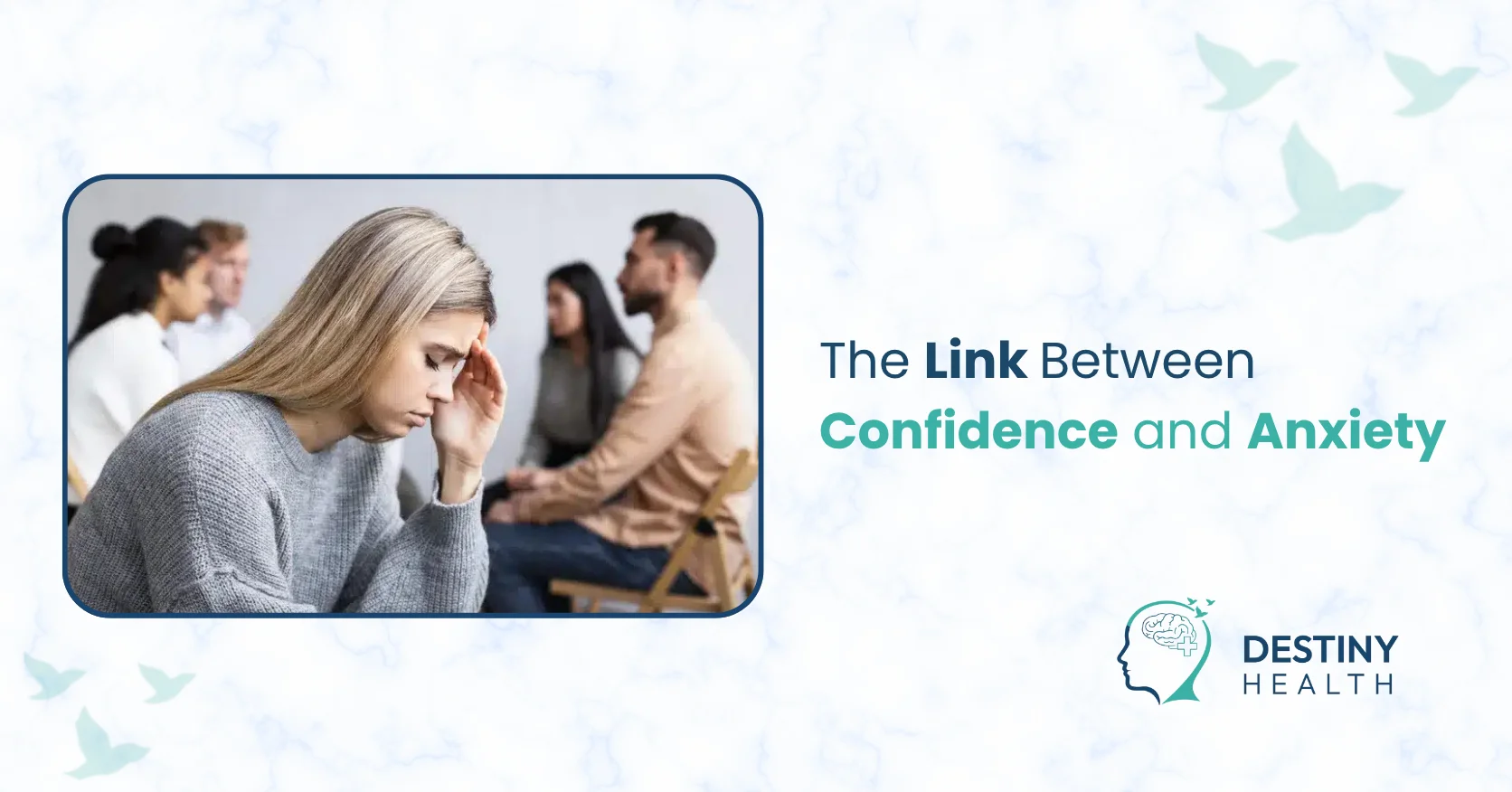
The majority of folks imagine that confidence and anxiety are opposites. If you could just feel more confident, feel that the anxiety would vanish. That’s not how it ever really works, though.
They connect, but the relationship is bidirectional with self-regenerative feedback loops. Low confidence makes anxiety worse. Anxiety chips away at confidence. And you hold both in place with a form of avoidance that offers up the illusion of protection, but over time quietly makes everything harder.
Through an understanding of the nature of the two, how they actually interact changes what you do about them.
The Cycle Nobody Points Out
This is what the loop looks like in action. You get nervous about something, a presentation, a social interaction, decision that may go wrong. That anxiety is telling you you’re likely in over your head. You step back, or overprepare, or endure it with your fingers crossed, it will all go okay. Regardless, you never really get proof that it is under control. That absence of evidence has cemented that low confidence.
Well, the next time something similar comes along, you are starting from square one again. Almost immediately, anxiety sets in – after all, nothing much has changed with the record your brain is keeping. You avoid it again, or bear it but you are not really there. The cycle completes.
This isn’t a character flaw. It is a pattern and it happens quite frequently. But basically, it also is not one that just breaks on its own because you want it to break.
What Avoidance Is Actually Doing
Avoidance is the thing that ties confidence and anxiety together. When anxiety shows up and you step back from whatever triggered it, the anxiety goes down. That’s the reinforcement. Your brain logs it as: avoidance worked. Do that again.
What your brain doesn’t log is what that avoidance cost. You didn’t find out that you could have handled it. You didn’t build any evidence of competence. The situation that felt threatening remains, in your mind, threatening, because you never got to learn otherwise.
Confidence, in a real and clinical sense, is built from experience. From doing things while anxious and getting through them. Not from feeling ready beforehand, because that feeling rarely comes. Avoidance cuts off the very experiences that would build the confidence that would eventually reduce the anxiety. That’s why the cycle is so persistent and why just telling someone to be more confident doesn’t do anything useful.
What Confidence Actually Is
Confidence isn’t the absence of doubt. It’s not certainty that things will go well. People who seem confident aren’t mostly people who have stopped feeling anxious. They’re people who have, through experience or therapy or both, developed a tolerance for uncertainty. They go into situations not knowing how it’ll go and they do it anyway, because their relationship with the discomfort is different.
That’s a learnable thing. It doesn’t come from repeating affirmations or thinking more positively. It comes from accumulated experience of surviving situations that felt hard, and from gradually updating the story the brain tells about what you’re capable of.
Where Anxiety Attacks Confidence Most
The internal commentary
Anxiety has a loud voice, and what it tells you is often about your own ability. You’re going to mess this up. Everyone else handles this fine. At this point, you should know how to do this. Because that sort of commentary will run through the minds of anxious people almost constantly, and is for all practical purposes indistinguishable from self-knowledge; it sounds true – because it feels true (even when it isn’t).
The catch is that anxiety-fueled self-talk doesn’t adjust according to new evidence the way regular thinking does. When you perform something well, anxiety will find a way to play down that achievement as well. You can get true positive reinforcement and still feel as if it was a lucky break.
What the body does
Anxiety has physical symptoms. Heart rate going up, breathing getting shallow, tension in the chest or the stomach.
For people already dealing with low confidence, those symptoms get interpreted as additional evidence of inadequacy. Your hands shake before the meeting and your brain reads that as: see, you can’t handle this.
The body’s reaction becomes part of the proof. Which makes the next anxious situation feel even more loaded, because you’re now also managing the fear of the physical symptoms themselves.
Clinicians call that second-order anxiety, being anxious about being anxious. It layers on fast and it’s one of the reasons anxiety tied to confidence can escalate quickly.
What Signs to Watch For
The confidence-anxiety link tends to show up in specific ways:
- You avoid situations not because you don’t want to be there but because you don’t trust yourself to handle them
- You over-prepare as a way of managing anxiety, but the preparation doesn’t actually make you feel more confident, just temporarily less scared
- You attribute successes to luck and failures to something inherent about you
- Compliments don’t land but criticism sticks for days
- You know intellectually that you’re capable of things you still refuse to believe emotionally
What Actually Helps
Cognitive behavioral therapy goes to and treats the thought patterns. The automatic self-criticism, the catastrophizing, and the minimization of contradictory evidence to the anxious narrative. At the same time, exposing yourself progressively to situations you fear gives your brain new information it needs to update.
DBT adds tools for managing the emotional intensity that comes up in that process. Mindfulness-based work helps create some distance between you and the anxious commentary so it stops functioning as fact.
Medication can be part of the picture too, particularly when anxiety is severe enough that it’s preventing engagement with any of the above. That’s a clinical decision, not a sign of failure.
Working With Destiny Health
Mercy Oyerinde at Destiny Health works with people navigating anxiety, low self-esteem, and the ways those two tend to reinforce each other. The approach pulls from CBT, DBT, ACT and mindfulness depending on what the person actually needs.
Care is available via telehealth and phone. Monday through Friday. If the confidence-anxiety loop sounds familiar and you’re ready to work on it with someone who takes the full picture seriously, reach out to schedule an appointment.
You don’t have to feel ready to start. That’s kind of the whole point.
Phone – (770) 676-2546
Email – support@destinyhealths.com
Hours – Monday to Friday, 9:00 AM to 5:00 PM EST
Website – destinyhealths.com
Confidence isn’t something you either have or don’t. It’s something that gets built, usually in the presence of the very anxiety you’re trying to get past.